Institutional FX Insights: Goldman Sachs USDJPY Trading Intervention

USD/JPY — Intervention Has Changed the Near-Term Distribution, but Not the Medium-Term Fundamentals
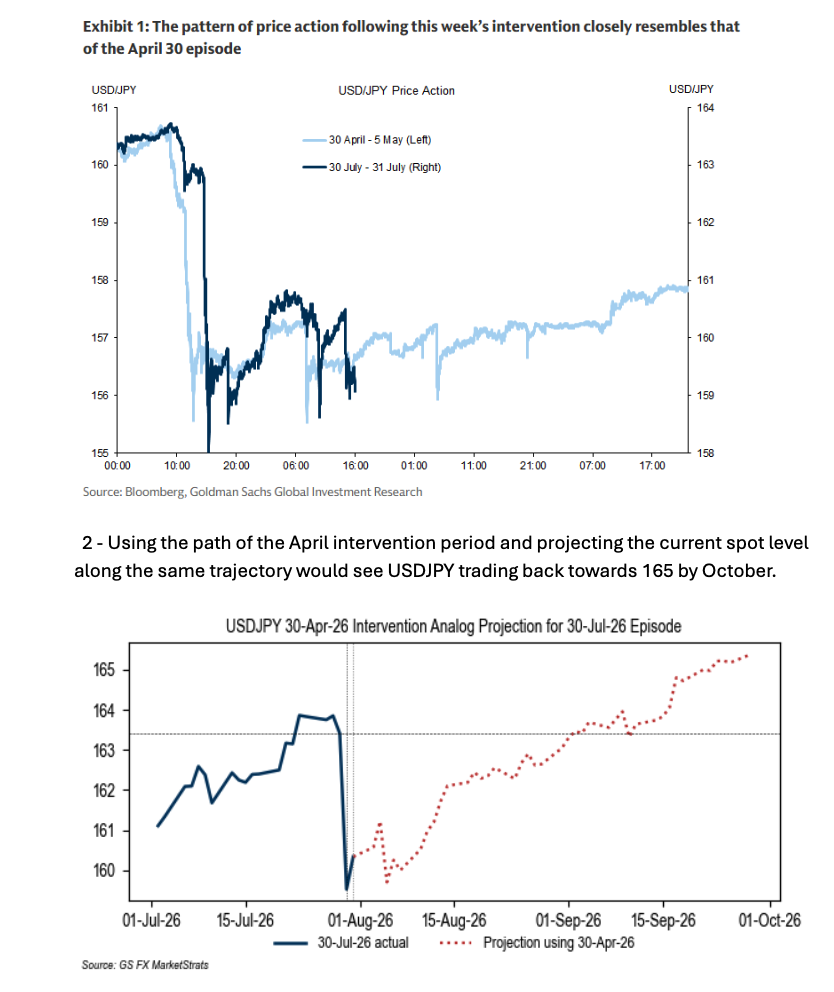
USD/JPY is trading in a tight 157.00–157.85 range this morning, opening around 157.25 in Wellington versus a 157.53 New York close, before settling around 157.80 into the Asia morning.
The key headlines are direct and important:
Katayama: Japan conducted joint intervention with the US in line with pact.
Katayama: Japan will not hesitate to conduct further joint intervention.
Katayama: The US has said Japan’s yen should be valued higher.
This is a meaningful escalation. The market is no longer dealing with unilateral Japan-only FX operations; it is dealing with coordinated US-Japan intervention and a more aggressive currency policy framework.
1. GS FX Strategy View: Intervention Is Large, Coordinated, but Fighting Fundamentals
Mike Cahill’s view is that last week’s intervention marked a new chapter in yen defense.
The key points:
Reported intervention by Japanese and US officials was extraordinary.
The cumulative Thursday / Friday operation was likely the largest two-day yen defense in 15 years.
It was notable both for size and coordination.
But the market response was modest relative to the scale of intervention and the fact that the US was involved.
That last point is crucial. If the largest coordinated intervention in 15 years only produces a limited market response, it suggests USD/JPY weakness is not merely speculative. It is supported by macro fundamentals.
The core GS strategy conclusion:
Intervention can manage the yen, but turning the trend requires a change in global conditions or Japanese domestic policy settings.
Japan has large reserves and can slow the move. But unless either US yields / USD soften materially or Japan tightens domestic policy / encourages repatriation, intervention alone may struggle to generate a durable yen bull trend.
2. Intervention Has Become More Aggressive and More Tactical
Praneet Shah’s FX options view highlights several changes in intervention style.
Larger Size
Thursday’s intervention size was estimated around US$60bn, compared with roughly US$25bn on days during the April / May intervention episode.
That is a major step-up.
Coordinated With the US
There was coordinated action with the US, including in EUR/JPY.
Using EUR/JPY is important because it can support the yen without signaling a broad USD selloff, which could risk destabilizing US Treasuries.
No Forewarning
The new intervention style appears to be surprise-based:
No forewarning
Catches the market off guard
More level-dependent than volatility-dependent
This matters because it raises the cost of being short yen. If intervention can arrive suddenly, stop-loss and gap risk increase.
3. EUR/JPY 187.50 Looks Like the Key Trigger
Although markets focus heavily on USD/JPY levels, Shah notes that EUR/JPY 187.50 appears to have triggered both rounds of intervention.
That is important because it suggests authorities may be watching the yen on a broader trade-weighted / cross basis, not just USD/JPY.
Key level:
Pair | Level |
|---|---|
EUR/JPY | 187.50 intervention trigger area |
USD/JPY | 158–160 objective / defense zone |
USD/JPY | 166 line in the sand from flows |
USD/JPY | 152/153 eventual tactical target |
USD/JPY | 147 gap from Oct 2025 Takaichi election |
The immediate objective appears to be keeping USD/JPY below 158–160.
4. Near-Term Setup: Asymmetric Lower in Cross-Yen
The short-term setup is asymmetric for further downside in X/JPY.
Reasons:
Japan and the US now appear vested in maintaining yen strength.
Authorities have “gone all in,” making it dangerous to fight intervention immediately.
Market remains short JPY.
CTAs remain short JPY.
Japanese retail remains short JPY.
The break of the 200-day moving average strengthens the technical case for lower USD/JPY.
More intervention is likely if USD/JPY trades above 158.
This creates a near-term risk that USD/JPY grinds or gaps lower, especially if leveraged short-yen positions are forced to reduce.
Shah’s target is not the full gap fill to 147, which he views as ambitious. His more realistic tactical target is 152/153.
5. Flows: Investors Are Fading Yen Strength, Not Chasing It
One of the more interesting points is that flows are skewed toward fading JPY strength through leveraged topside.
In other words, many investors are using yen rallies / USD/JPY dips to re-enter long USD/JPY exposure, rather than buying yen optionality for further downside in USD/JPY.
That is important because it means:
The market still believes medium-term yen weakness fundamentals remain intact.
Positioning remains vulnerable if authorities continue intervening.
There is surprisingly little appetite to chase a continued yen rally.
Optionality demand is not extreme despite the policy shift.
FX vol rose, with 1-month ATM USD/JPY vol moving from around 6.0v to 8.5v, implying an approximate 1.9% straddle breakeven.
At spot around 157.80, a 1.9% breakeven is roughly:
157.80×0.019=3.0157.80×0.019=3.0
So the 1-month straddle is pricing an approximate move of 3 yen, or a rough breakeven range near:
154.8 to 160.8154.8 to 160.8
That range is important because the upper side overlaps with the apparent official defense zone.
6. USD/JPY Technicals: 200-Day MA Break Matters
Shah notes that USD/JPY has broken the 200-day moving average. This is technically significant because many systematic / CTA frameworks use longer-term moving averages as trend signals.
If USD/JPY remains below the 200-day:
CTA short-yen positions may be pressured.
Momentum signals may flip.
Volatility can stay elevated.
Further downside toward 152/153 becomes more plausible.
But if USD/JPY quickly reclaims 158–160, it would challenge the credibility of the intervention effort and likely force another official response.
7. Medium-Term: Yen Fundamentals Are Still Weak
Despite the near-term intervention risk, Goldman is not arguing that the medium-term yen bear case has disappeared.
The structural yen-negative backdrop remains:
Loose monetary policy in Japan
Loose fiscal policy
Wide rate differentials
Slow-moving repatriation flows
Need for actual policy tightening or inward FDI realization
Risk that reserve depletion reduces future intervention ammunition
This is the key tension:
Near Term
Authorities can compress USD/JPY lower through coordinated intervention and positioning pressure.
Medium Term
Unless Japan changes domestic policy or global yields fall materially, fundamentals still argue for renewed yen weakness.
The danger is that heavy intervention now could deplete reserves and potentially store up risk for a larger future JPY weakening episode if policy settings remain loose.
8. Broader USD Implications
Shah also makes an important point about the broader dollar.
The overall USD picture now looks more negative because:
USD/JPY has turned lower.
EUR/USD is breaking technical levels higher.
Positioning is caught long USD.
Warsh’s credibility issues have generated a bearish USD curve signal.
The post-FOMC twist steepening is historically bad for USD.
This ties directly into JPM’s FX FOMC view: the most USD-negative configuration is lower front-end nominal rates combined with higher long-end inflation / term premium.
That is:
Lower Front-End Yields+Higher Inflation/Term Premium→USD NegativeLower Front-End Yields+Higher Inflation/Term Premium→USD Negative
If USD/JPY intervention pressure overlaps with broad USD weakness, USD/JPY downside can extend more easily.
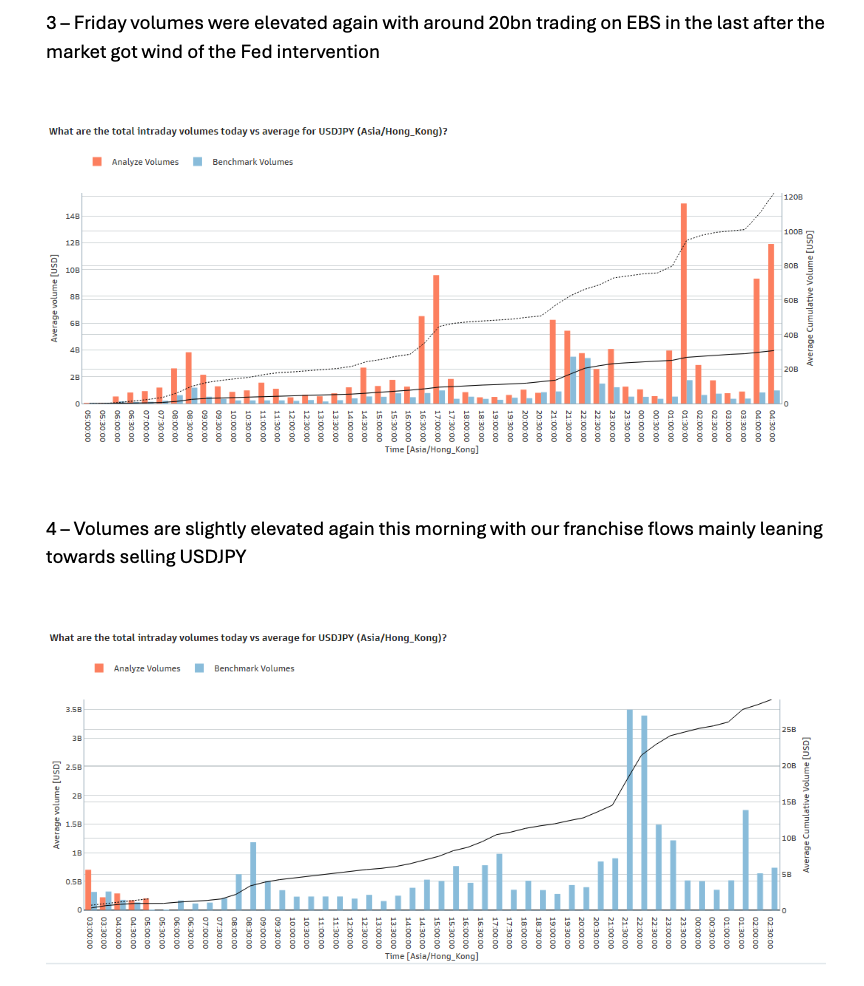
9. Using the April Episode as a Guide
The note suggests the current price action feels similar to the April–May intervention episode, but with some important differences.
Similarities
Sharp official intervention
Market initially surprised
Yen rallies abruptly
Investors test the authorities
Vol rises
Short-yen positions are pressured
Differences
Current intervention size appears much larger.
Current action is coordinated with the US.
Intervention is less telegraphed.
EUR/JPY appears to matter more.
Authorities may be more level-dependent.
USD backdrop is now weaker due to Fed credibility issues.
Because of those differences, the current episode may have more near-term staying power than April / May, even if medium-term fundamentals remain yen-negative.
10. Tactical Trading Framework
Near-Term Bias
Bias is lower USD/JPY / lower XJPY while spot remains below 158–160, especially if authorities remain vocal.
Preferred tactical view:
Do not fight intervention immediately.
Sell rallies above 158 if intervention risk remains credible.
Watch EUR/JPY around 187.50.
Target 152/153 as a realistic downside objective.
Treat 147 as a stretch / gap-fill target, not base case.
Key Levels
Level | Significance |
|---|---|
166 | Flow “line in the sand” / leveraged topside area |
160 | Upper official defense objective zone |
158 | Likely renewed intervention risk threshold |
157.80 | Current Asia morning area |
157.00 | Morning range low |
152/153 | Shah’s eventual tactical downside target |
147 | Oct 2025 Takaichi election gap, ambitious target |
Options
Given 1-month ATM vol around 8.5v and a roughly 1.9% straddle breakeven, optionality is not cheap versus the prior 6.0v, but it is not extreme given intervention and gap risk.
Potential expressions:
USD/JPY put spreads for limited-loss downside.
EUR/JPY downside structures given apparent 187.50 trigger.
Avoid naked topside USD/JPY exposure above 158–160 due to intervention risk.
Use rallies to reset hedges rather than chase downside after sharp moves.
Disclaimer: The material provided is for information purposes only and should not be considered as investment advice. The views, information, or opinions expressed in the text belong solely to the author, and not to the author’s employer, organization, committee or other group or individual or company.
Past performance is not indicative of future results.
High Risk Warning: CFDs are complex instruments and come with a high risk of losing money rapidly due to leverage. 69% and 73% of retail investor accounts lose money when trading CFDs with Tickmill UK Ltd and Tickmill Europe Ltd respectively. You should consider whether you understand how CFDs work and whether you can afford to take the high risk of losing your money.
Futures and Options: Trading futures and options on margin carries a high degree of risk and may result in losses exceeding your initial investment. These products are not suitable for all investors. Ensure you fully understand the risks and take appropriate care to manage your risk.
Patrick has been involved in the financial markets for well over a decade as a self-educated professional trader and money manager. Flitting between the roles of market commentator, analyst and mentor, Patrick has improved the technical skills and psychological stance of literally hundreds of traders – coaching them to become savvy market operators!